


By 2025, businesses are investing billions of dollars in marketing strategies like email, social media, influencer marketing, and paid advertising. While these are all effective methods, the value of existing customers is often overlooked.
Word-of-mouth marketing provides an opportunity to reach a group of people that might otherwise be missed. Referral programs, a form of word-of-mouth marketing, are facilitated by software like ReferralCandy.
This article will explore not just referral programs but the broader concept of word-of-mouth marketing. We will discuss various strategies, along with successful examples of word-of-mouth marketing campaigns.
Let’s start by defining word-of-mouth marketing.
What is word of mouth marketing?
Word-of-mouth marketing (WOM marketing) is a strategy that relies on customer recommendations to promote your product or service. The goal is to create a positive customer experience that encourages customers to recommend your business to others.
Successful word-of-mouth advertising involves implementing a range of strategies.
For instance, a popular fashion retailer might establish a referral program where customers receive a $15 discount for each friend they refer who makes a purchase. This incentivizes existing customers to share their positive experiences and attracts new customers through trusted referrals.
4 reasons why word of mouth marketing is so powerful
Word-of-mouth marketing is effective because consumers trust recommendations from people they know. It is also cost-effective, taps into new revenue streams, builds a community of brand advocates, and can be scaled.
Let’s delve into each of these reasons.
1. Consumers trust recommendations from friends and family
The primary strength of word-of-mouth marketing lies in the fact that 88% of consumers trust recommendations from people they know. Personal recommendations are perceived as more genuine and less biased than traditional advertising.
2. Doesn’t take money from existing customers
Unlike many marketing methods, word-of-mouth marketing often does not require financial input from existing customers. The revenue generated through word-of-mouth referrals is typically new revenue from referred customers.
For example, implementing a referral program can encourage existing customers to recommend your products to their network, thus accessing a customer base that may have been otherwise untapped.
3. Builds a community of brand advocates
Effective word-of-mouth marketing strategies can cultivate a community of brand advocates over time. These advocates go the extra mile to recommend your products or services to others, both online and offline.
4. It is a scalable marketing strategy
While word-of-mouth marketing is not commonly viewed as a scalable approach, there are strategies that can turn it into a sustainable, long-term strategy. These strategies, known as ‘word of mouth marketing strategies,’ will be discussed further.
7 word of mouth marketing strategies you can start implementing today
There are numerous word-of-mouth marketing strategies available, but we will focus on seven highly effective approaches.
Let’s begin with the first strategy!
1. Maintain a great customer lifecycle
Enhancing the customer lifecycle is arguably the most impactful way to boost word-of-mouth marketing. The customer lifecycle comprises five stages: reach, acquisition, conversion, retention, and loyalty.
All stages of the customer lifecycle should be optimized to encourage customers to naturally recommend your products to others.
Here are specific actions related to each stage of the customer lifecycle:
- Reach: During this stage, customers are discovering your brand and comparing it to competitors. To win them over, clearly articulate how your products solve their problems, ensure your brand is easily searchable on Google, and engage with customers on social media by sharing relevant content and addressing queries. Understanding the differences between platforms like TikTok and YouTube can help tailor content to your target audience.
- Acquisition: In this stage, customers have visited your website. The focus should be on guiding them towards making a purchase by showcasing customer reviews, educating them on the benefits of your products, and providing relevant information on pricing and features through content offers, pricing pages, and blog posts.
- Conversion: The conversion stage occurs when a customer makes a purchase. It is crucial to ensure a seamless post-purchase experience to foster customer loyalty. Incorporating strategies like digital experimentation can optimize this stage and improve customer retention. Enhance post-purchase communication, provide order tracking details, and offer valuable product information through blogs.
- Retention: During this stage, the focus shifts to maintaining and strengthening the customer relationship. Sending follow-up emails to gather feedback, offering discounts for future purchases in exchange for reviews, and inviting customers to join referral programs can help solidify loyalty.
- Loyalty: At this stage, customers become invaluable advocates for your brand. They may leave reviews, share their experiences on social media, and recommend your products to others. To sustain their loyalty, consider organizing giveaways, establishing loyalty programs, and consistently delivering valuable content.
By optimizing these five stages of the customer lifecycle, you can enhance customer satisfaction, leading to natural word-of-mouth recommendations.
2. Launch your referral program
Referral programs incentivize existing customers to promote your products to their networks. For a seamless referral program, follow these steps:
- Select referral program software. Effective referral software, like ReferralCandy, is essential for scaling your program. It enables you to set up the program, trigger post-purchase notifications, automate rewards, and track performance.
- Define referral incentives. Incentives, such as cash rewards or discounts, motivate customers to refer your products. For example, offering a ‘Give $10, Get $10’ discount can encourage referrals.
- Create a referral landing page. A well-designed landing page simplifies the referral process. Include a clear call-to-action, prominently display rewards, and offer an easy sign-up form for customers.
- Promote the program to customers. Use post-purchase emails to invite customers to join the referral program. For existing customers, send dedicated emails introducing the program and its benefits.
Monitoring the program’s performance continuously is crucial for generating more referrals.
3. Utilize social media effectively
Effective use of social media can significantly enhance word-of-mouth marketing. Let’s explore how a brand like Oodie leverages social media:
With over 400,000 followers on Instagram, Oodie showcases customer stories daily, featuring their wearable long hoodies.
Through emails, Oodie encourages user-generated content, which is then shared on their Instagram feed.
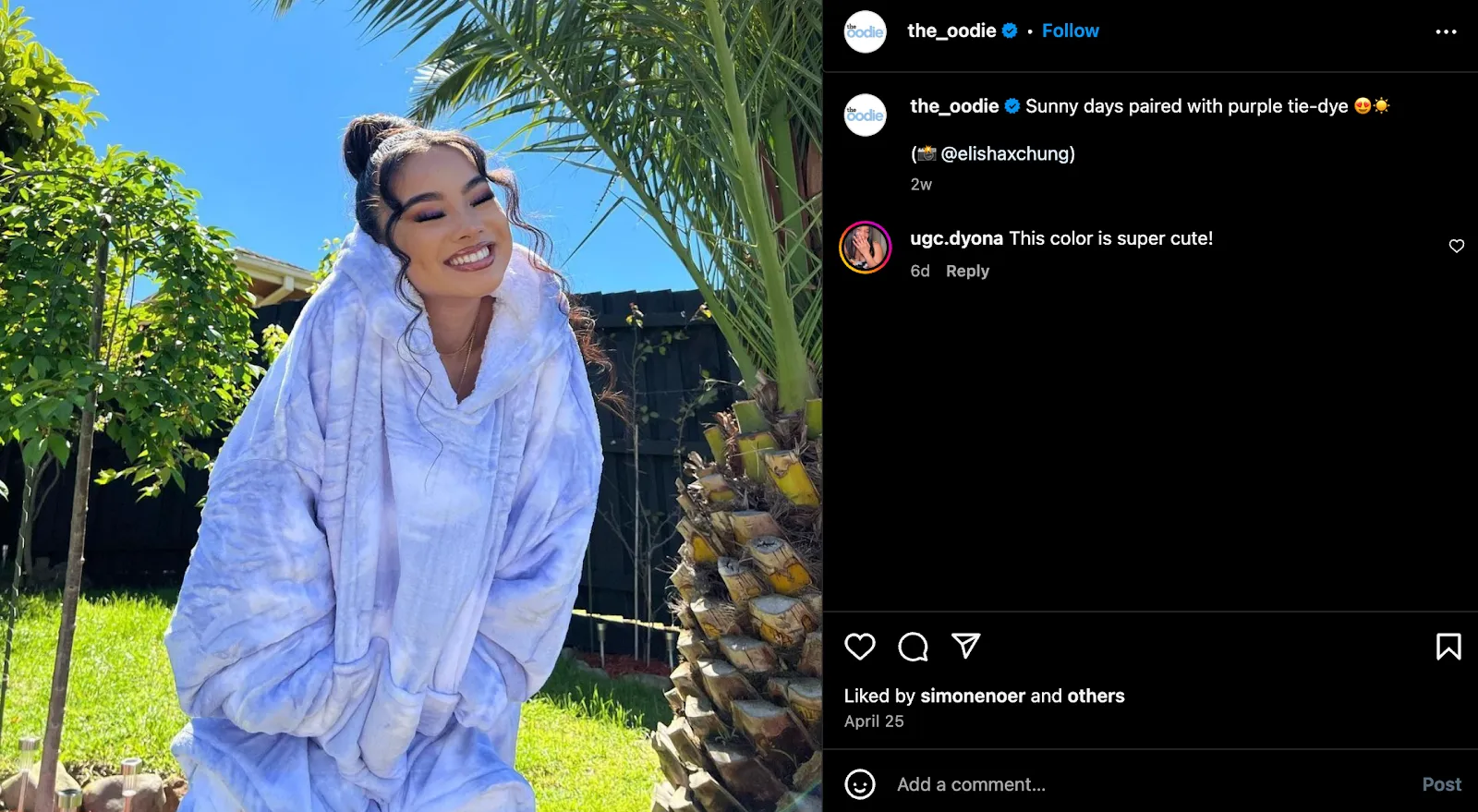
From a word-of-mouth marketing perspective, this approach offers several benefits. Firstly, Oodie receives organic engagement from customers sharing their products on Instagram. Secondly, potential customers are more likely to join the community after witnessing the strong social presence Oodie has built. This community-building can lead to customers inviting others to join and engage with the brand.
You can similarly foster a community among your customers, utilizing social media and email channels.
4. Encourage user-generated content
Research indicates that 81% of marketers believe visual user-generated content resonates more with customers than professionally shot photos. User-generated content is perceived as less aggressive, fostering greater trust in the brand.
Incentivize customers to create user-generated content by offering rewards, such as discounts or chances to win free products.
5. Leverage influencer marketing
Influencer marketing is a rapidly growing industry, projected to reach $24 billion by 2024. This form of marketing complements word-of-mouth advertising effectively.
To leverage influencer marketing, collaborate with influencers to promote your products on their social media platforms. In return, they direct their followers to your website, potentially driving new customers. Influencer marketing often aligns with affiliate marketing programs, allowing brands to reward influencers for each sale generated.
You can reach out to influencers via email or directly on social media platforms.
6. Collect and showcase customer reviews
Nearly all consumers (99.9%) read reviews when shopping online, with 98% considering reviews essential for purchase decisions. Authentic customer reviews hold significant power in influencing buying behavior, making them invaluable for word-of-mouth marketing.
To collect reviews, send automated emails to customers post-purchase, offering incentives like discounts for their next order. Ensure email verification to enhance deliverability. Display collected reviews on relevant pages where additional social proof is needed.
Common locations for showcasing reviews include product pages, home pages, social media pages, emails, and dedicated review sections.
By collecting and displaying reviews, you can sway consumers who are on the fence about purchasing from your brand.
7. Provide memorable customer experiences
Brands that leave a lasting impact often go above and beyond to exceed customer expectations. Such exceptional experiences can lead customers to recommend the brand to others.
Simple gestures, like remembering customer names, offering complimentary products, hosting giveaways, creating educational content, or aligning with a larger mission, can make customers feel valued and more likely to advocate for the brand.
These are just a few ways to enhance customer experiences!
Top word of mouth marketing examples
Let’s explore three successful word-of-mouth marketing examples from ecommerce brands, highlighting their strategies for success:
1. Branch Basics: This eco-friendly cleaning brand utilized ReferralCandy to launch a referral program, offering discounts to both first-time customers and referrers. Through targeted emails and a well-designed landing page, Branch Basics generated over $1.5 million in sales, with referral sales accounting for close to 10% of total sales.
2. 4Ocean: Known for their bracelet that cleans five pounds of trash with each purchase, 4Ocean leveraged viral marketing on Instagram to build a following of 3+ million users. Their impactful content focused on ocean cleanup efforts and wildlife protection, driving customer acquisition through word-of-mouth recommendations.
3. Endy: Endy excels in collecting and showcasing customer reviews on their website and social media platforms. By sending post-purchase review requests and prominently displaying reviews, Endy has amassed over 30,000 reviews, enhancing social proof and influencing potential customers.
Word of mouth marketing strategy checklist
In conclusion, here is a checklist of seven effective word-of-mouth marketing strategies for your consideration:
- Maintain a strong customer lifecycle through all stages, focusing on reach, acquisition, conversion, retention, and loyalty.
- Launch a referral program using dedicated software like ReferralCandy.
- Harness the power of social media to build a community and engage with customers.
- Explore influencer marketing opportunities on platforms like Instagram and TikTok.
- Encourage customers to create user-generated content and share it across channels.
- Collect and showcase customer reviews on various platforms, including your website, social media, and emails.
- Deliver exceptional customer experiences through personalized gestures and value-added services.
By implementing these strategies, you can enhance customer satisfaction, drive organic referrals, and build a strong word-of-mouth marketing presence. This is the essence of effective word-of-mouth marketing!
Further reading
For additional insights on enhancing your word-of-mouth strategy, consider exploring the following articles:
- 22 Examples of Providing Practical Value in Marketing
- The 7 Best Referral Program Ideas (And One That Doesn’t Work)
- How to Use Referral Marketing to Scale Your Organic Customer Acquisition
P.S. If you found this article helpful, explore our pricing plans to kickstart your referral program today and convert word-of-mouth into tangible sales.


