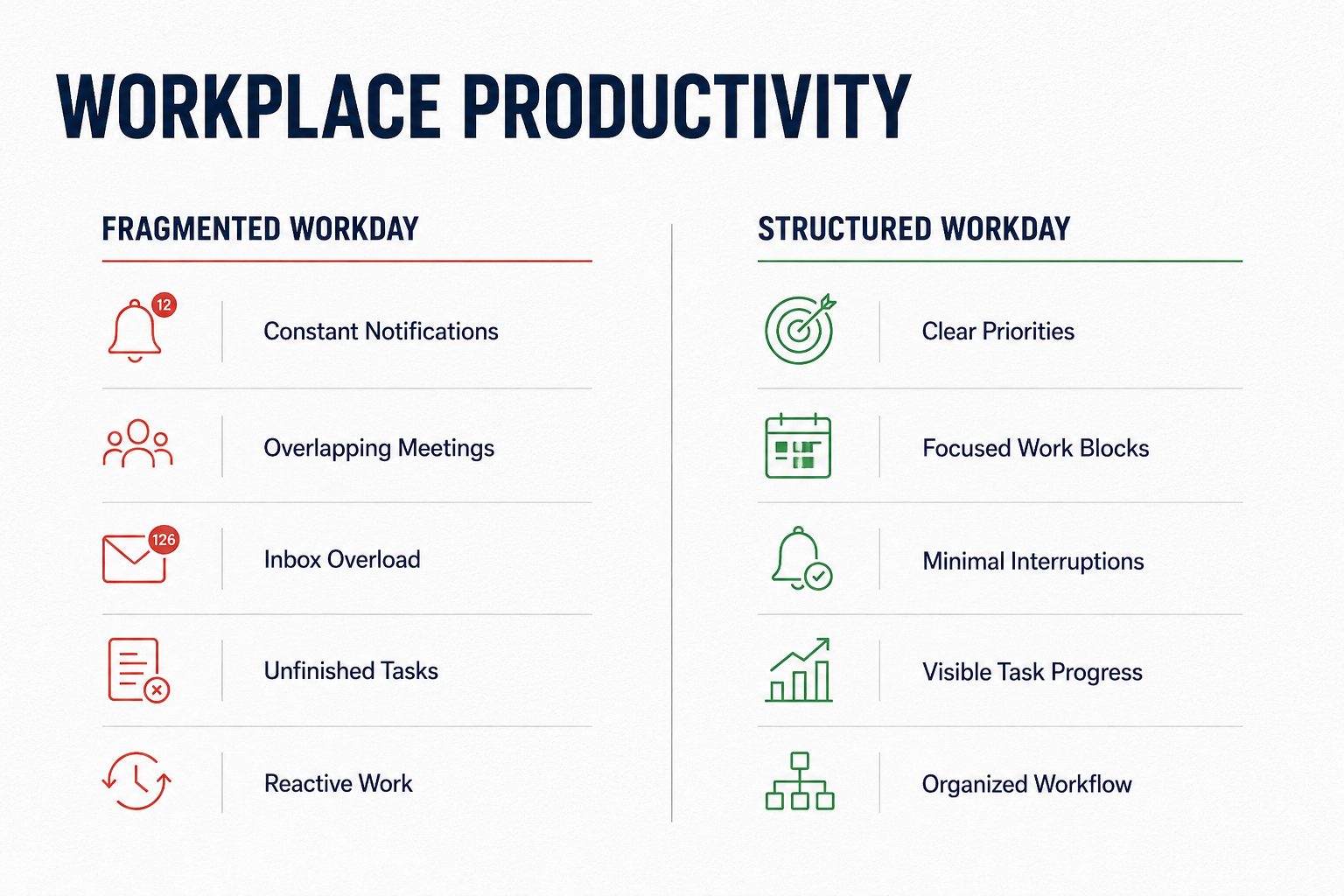
In 2026, productivity is not greatly affected by a lack of effort. The real issue lies in how easily the workday becomes fragmented. Hours slip away into tasks that may seem productive but do not actually push important work forward. Constant email threads, consecutive meetings, never-ending notifications, and status updates keep people occupied, while actual work gets postponed.
The challenge is that these habits often give the illusion of progress. Spending all day checking emails may feel like staying informed. Sitting through long meetings may feel collaborative. However, in reality, these activities break focus and decrease the amount of meaningful work accomplished.
An analysis of the workplace in 2025 revealed that employees spend about 60% of their time on “work about work” instead of their core responsibilities. This leads to missed deadlines, more rework, slower progress, and increased stress among teams.
Enhancing productivity begins with understanding where time is actually being spent. The guide below examines some of the major time-wasting activities in the workplace and offers practical ways to minimize them.
Key takeaways from this article:
- A clear definition of time wasters and why they are difficult to identify
- The real impact of wasted time on businesses and individuals
- Eight common workplace time wasters explained clearly
- Seven practical strategies to reduce each time waster
- How TMetric exposes hidden time waste so it can be addressed
What are time wasters?
A time waster is anything that consumes time and attention without contributing to meaningful work outcomes. This means that some of the most damaging time wasters may not be obvious distractions like social media or personal calls; they often masquerade as legitimate work.
Studies indicate that the average worker spends 51% of their workday on tasks that add little to no value: unclear priorities, inefficient processes, unnecessary back-and-forth communication, and performative work that signifies busyness but yields no results. This persistence of time-wasting activities is primarily due to the lack of a formal time management system, with 82% of individuals lacking a structured framework for determining task priorities. Consequently, the default approach is to respond to whatever seems most urgent, which often does not align with the most critical work.
Why time wasters matter at work
Before jumping to solutions, it is essential to understand why time wasters pose a significant problem. The repercussions extend beyond individual efficiency, evolving into a broader business issue when accumulated across a team.
Impact on productivity and focus
Every interruption and subsequent recovery incurs a hidden cost. Research from the University of California, Irvine reveals that it takes an average of 23 minutes and 15 seconds for employees to regain the same level of focus on the original task after an interruption. With repeated interruptions throughout the day, such as notifications, meetings, or ad hoc requests, individuals spend most of their time in a superficial mode, never reaching the focused state where high-quality work is accomplished.
The American Psychological Association notes that chronic multitasking and frequent context switching can consume up to 40% of an individual’s productive time. This means that, for an eight-hour workday, approximately three hours are lost due to constant reorienting between tasks, tools, and conversations, rather than actual work.
Impact on stress, deadlines, and work quality
Wasted time does not vanish; instead, it becomes compressed. When low-value activities consume hours, the actual work is hurried, completed after hours, or left unfinished. This rush leads to missed deadlines and necessitates rework because speed, without focus, results in errors.
The stress accumulates over time. Employees end their day feeling busy but lagging behind. Eventually, this disparity between effort and progress contributes to disengagement, signaling that the issue is systemic rather than individual.
Common time wasters at work
This section provides a practical breakdown of the most prevalent time-wasting activities in the workplace. For each example of time wastage, a description is provided, along with an explanation of why it consumes time and the consequences it leads to.
Unnecessary meetings
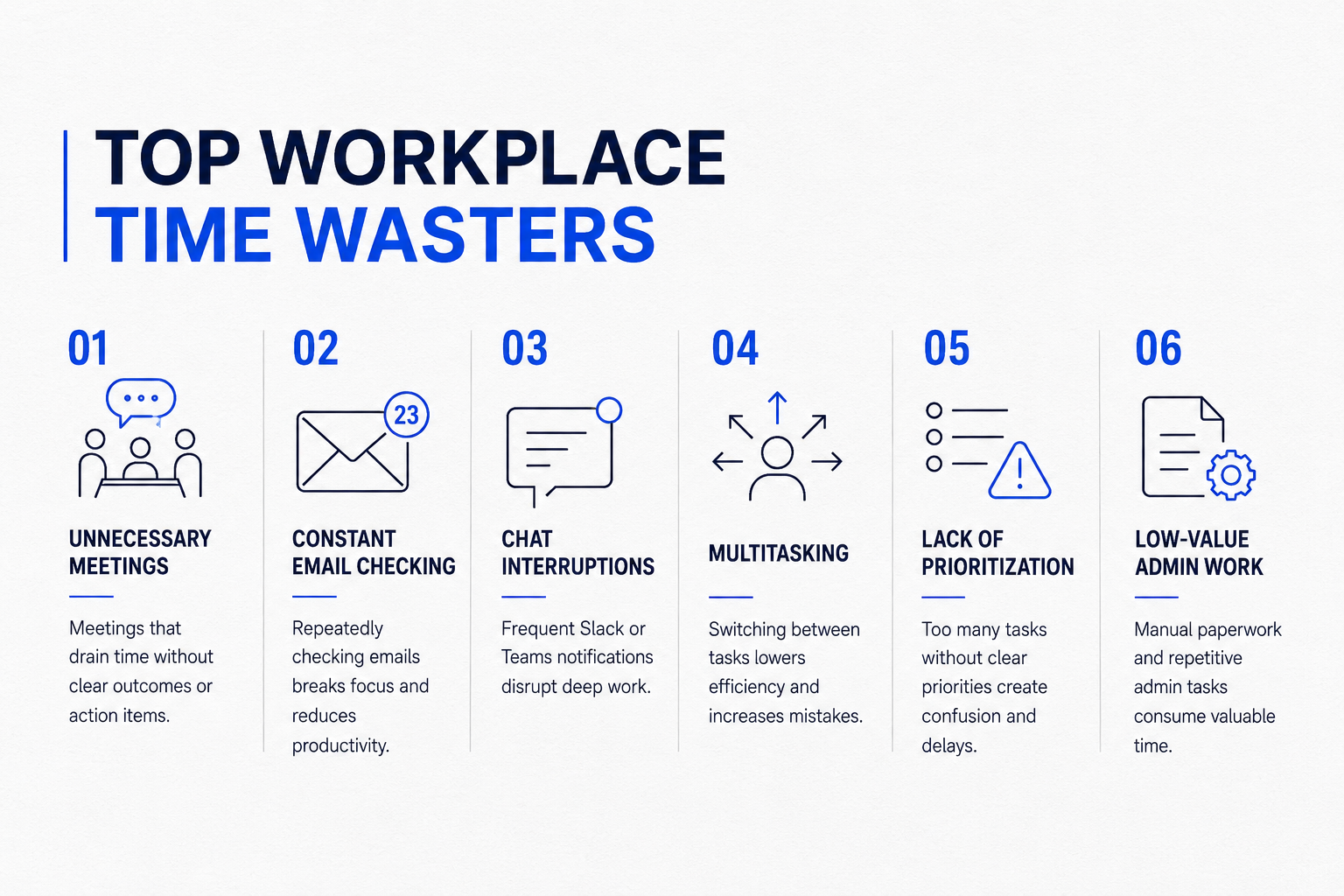
Meetings rank as the primary productivity drain for 47% of employees. U.S. businesses lose $37 billion annually due to unnecessary meetings, with the average worker spending 21.5 hours per week attending them. These interruptions fragment the day, making focused work nearly impossible. A meeting lacking a clear agenda or designated decision-maker is essentially an interruption disguised as a scheduled event.
Constant email checking
Checking an inbox 121 times per day accounts for 28% of the workweek. Despite most messages not being urgent, the habit of continuous monitoring perpetuates a cycle of fragmented attention. Email often serves as a subpar communication channel, where lengthy threads and unclear requests overshadow meaningful progress.
Chat notifications
Tools like Slack and Teams act as a secondary, faster inbox. Over 50% of workers feel compelled to respond immediately, creating a perpetual state of partial presence. Each query mid-task forces the brain to switch contexts, resulting in significant cognitive overhead throughout the day.
Multitasking and context switching
Rapidly shifting between tasks is inefficient. Knowledge workers switch between apps nearly 1,200 times daily, losing four hours per week to reorientation, which amounts to approximately five weeks per year. Following a single switch, refocusing on demanding tasks can take up to 15 minutes, leaving more time spent “orienting” than actually working.
Lack of prioritization
Reactive work patterns emerge when 82% of individuals lack a formal time management system. Without clear priorities, tasks of high urgency but low importance tend to overshadow strategic objectives. This default approach ensures that the most recent inbox item receives the most attention, irrespective of its actual value.
Busywork and low-value admin
Repetitive manual tasks cost businesses $1.8 trillion annually. Employees lose approximately 50 days per year to basic administrative tasks, such as formatting reports that go unread or attending irrelevant meetings. Busywork persists as a drain because it often signifies “participation” while yielding no tangible outcomes.
Procrastination disguised as preparation
Oftentimes, excessive research or reorganizing of files is used as a defense mechanism against challenging tasks. The avoidance is evident when the preparation time far exceeds the project’s actual complexity. This behavior is characterized by a significant “output gap” between time spent and progress achieved.
Poor handoffs and unclear ownership
Work stalls when tasks lack a specific owner or deadline. Dependencies remain unresolved as individuals wait for others to take the lead. This coordination gap can transform a one-day task into a week-long delay, making it one of the most costly systemic time wasters in the workplace.
Time wasters and how to avoid them
Eliminating time waste does not necessitate a flawless system but rather identifying the most significant drains and reducing them enough to allow meaningful work to flourish.
Below are practical actions categorized by the most common problem areas.
Audit how time is actually spent
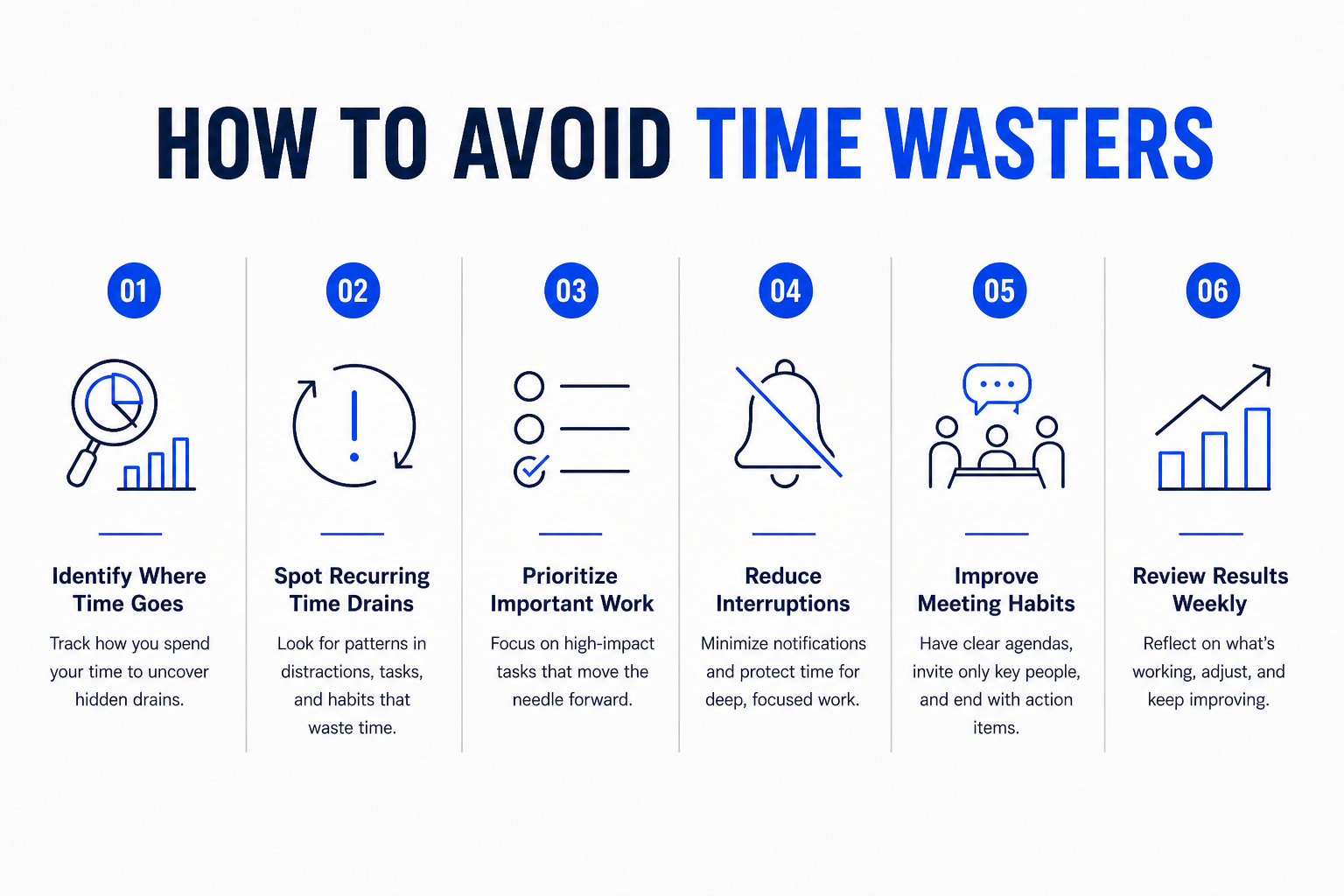
Estimations regarding high-value work are often overly optimistic. Monitoring time in detail for a week, recording specific tasks like meetings, email correspondence, and administrative work, unveils the reality. Patterns typically emerge within days, highlighting two or three categories that consume the most hours. Prioritize efforts in those areas first to avoid wasting time optimizing the wrong activities.
Prioritize high-value work first
Guarding the initial 90 minutes of the day for the most critical task is a high-impact habit. The mind is sharpest in the morning, and distractions have not yet accumulated. Identifying one to three essential tasks each morning ensures a productive day, regardless of how the remaining hours are spent.
Reduce meetings and make them more effective
Regularly reassess recurring meetings. Cancellations or reduced frequencies are often necessary when meetings fail to produce a plan or decision. Research involving 76 companies revealed that a 40% reduction in meeting time resulted in a 71% increase in productivity. Effective meetings require a predefined agenda, a limited number of attendees, and a clear outline of next steps.
Control notifications and safeguard focus time
Disabling push notifications during focused blocks breaks the cycle of constant interruptions. Microsoft’s 2025 Work Trend Index highlighted that employees encounter a digital interruption every two minutes during core hours. Consolidating responses to two or three specified times per day allows for deeper concentration. Team tools can indicate these “focus mode” statuses to manage colleague expectations.
Cease multitasking and work in blocks
Assigning tasks to specific time blocks is more efficient than multitasking. Even 60 minutes of uninterrupted focus yields more results than a full day of fragmented attention. This is especially true for complex tasks like coding, strategy development, or analysis. A study in 2024 indicated that intense multitasking can reduce cognitive performance by up to 10 IQ points, a significant decline comparable to losing a night of sleep.
Automate, delegate, or remove low-value tasks
Repetitive administrative tasks should be automated, delegated, or eliminated. Many tasks persist out of habit. Estimates suggest that automation could reclaim 520 hours per employee annually from repetitive manual tasks. Tools, templates, and streamlined processes can often eliminate this excess workload entirely.
Review time wasters weekly
Devoting 15 minutes each Friday to review the week fosters essential accountability. Analyzing recurring interruptions and time-consuming tasks helps identify issues before they escalate. This routine makes it challenging to overlook the patterns that typically lead to a wasted schedule.
How TMetric helps you spot and reduce time wasters
Most time waste remains invisible without data. Individuals may feel busy, but without a record of actual time allocation, they lack a reliable means to pinpoint specific activities draining hours from meaningful work.

TMetric, a time tracking software, unveils the hidden waste. By tracking time at the task level, this work time tracker provides individuals and teams with an accurate overview of where their working hours are truly spent, rather than where they assume time is allocated. Given that 89% of workers confess to wasting time daily, often underestimating the extent, TMetric bridges the gap between perceived and actual time utilization.
See exactly where time goes
TMetric’s task-level time tracking enables the recording of time against specific activities during work. At the end of the day or week, individuals can observe precisely how much time was dedicated to meetings, email management, administrative duties, project delivery, and other tasks. The emerging pattern is typically different from what individuals expect.
For teams, the dashboard displays real-time workload distribution across all members:
- Identifying over-allocated individuals
- Tracking individuals with low workload
- Identifying misalignments between time allocation and priorities
Utilize reports to identify recurring drains
TMetric’s reporting suite, including task summaries, project reports, and activity breakdowns, allows for a detailed analysis of time data at various levels. Users can examine a single individual’s week, a project’s total logged hours compared to estimates, or a team’s breakdown across all ongoing tasks.
Cultivate better habits with idle detection and timesheets
Unlike standalone timers, TMetric operates as a task manager with integrated time tracking within the workflow. Tasks are assigned estimates, projects have budgets, and every tracked hour automatically feeds into reports, maintaining current data without additional effort. Idle detection ensures that logged hours reflect actual work, while timesheet submission and approval workflows render patterns visible to managers without manual oversight.
Experience TMetric for free and commence tracking work that truly matters. The free version accommodates up to two users without requiring a credit card.
Key takeaway
Time wasters at work often go unnoticed, blending into daily routines—the reflexive inbox check, the meeting more suitable for a quick message, or the planning session that remains in discussion. This camouflage renders them remarkably persistent as these activities feel productive in the moment.
A substantial portion of the workday is absorbed by interruptions, cluttered communication threads, and low-value tasks that overshadow significant projects. The objective is to establish a clear schedule by eliminating the most significant sources of