


Please note: This article is intended for general information purposes only and does not constitute legal advice.
Quick reminder: When you have a financial connection with a product or merchant, clearly disclose it in straightforward language, right alongside the endorsement or link. Do not solely rely on platform labels. Also, be aware of the FTC’s 2024 Consumer Reviews & Testimonials Rule, which prohibits fake or manipulated reviews and imposes penalties for violations.
Merchants often inquire about creating an FTC Affiliate Disclosure and its necessity. The Federal Trade Commission (FTC) mandates disclosing relationships that could impact the promotion or endorsement of products.
Regardless of the scale of the promotion, all affiliate marketers must adhere to this requirement. The FTC Affiliate Disclosure serves this purpose, promoting transparency with audiences and ensuring legal compliance.
This article outlines what an FTC Affiliate Disclosure entails, why it is essential, who needs it, and best practices for its creation. Armed with this knowledge, you can easily craft an affiliate disclosure for yourself.
Note: For those looking to establish an affiliate program for their ecommerce brand, consider using ReferralCandy. It offers a 30-day free trial and can assist in launching and expanding your first affiliate or referral program.
Table of Contents
- What is an FTC affiliate disclosure?
- Who should use an affiliate disclosure?
- Why is an FTC affiliate disclosure necessary?
- How to craft an FTC affiliate disclosure?
- 7 examples of FTC affiliate disclosures
- FAQ
- Conclusion
What is an FTC affiliate disclosure?
An FTC affiliate disclosure is a mandatory statement set by the Federal Trade Commission (FTC) for affiliate marketers to inform their audience about any financial relationships or incentives they have with the products or brands they promote.
For instance, if a beauty blogger reviews a new skincare product and includes affiliate links for purchasing that product, they must disclose that they earn a commission from sales through those links.
As an affiliate marketer, you may receive compensation in various forms, such as:
- Commission on sales
- Free products or services
- Performance bonuses
- Pay-per-click
- Pay-per-lead
- Flat fees
Regardless of the compensation type, it must be disclosed to consumers through an affiliate disclosure.
Who should use an affiliate disclosure?
Anyone promoting products/services online and receiving compensation must utilize affiliate disclosures. This includes bloggers, social media influencers, content creators, website owners, podcasters, YouTubers, and others promoting products or services.
Why is an FTC affiliate disclosure necessary?
An FTC affiliate disclosure is essential for several reasons:
- Legal compliance: The FTC mandates disclosing affiliate relationships to consumers. Failure to comply may result in legal repercussions such as fines and penalties.
- Transparency: Disclosing affiliate relationships helps maintain transparency with the audience, similar to referral marketing programs where trust drives customer engagement. Affiliate disclosures ensure customers are aware of potential biases and understand promoters may be compensated for product promotion.
- Trust and credibility: FTC affiliate disclosures build customer trust and credibility. Without them, internal company members could promote their products for payments, which the disclosure safeguards against.
- Informed decision-making for customers: When consumers know a recommendation is incentivized, they can evaluate that information and make informed choices.
How to craft an FTC affiliate disclosure?
Creating an effective FTC affiliate disclosure involves several steps to ensure transparency and compliance with regulations. The following steps are based on the FTC’s recommendations for creating affiliate disclosures.
1. Choose an appropriate placement for the affiliate disclosure
Position the affiliate disclosure where consumers are likely to see it, such as near affiliate links or prominently within the content. Ensure consumers can easily associate the disclosure with the specific product or service being promoted without having to search for related information elsewhere.
For example, Forbes places their disclosure prominently:
Avoid placing the disclosure in obscure locations like the bottom of a webpage or where consumers are unlikely to look, such as sidebars or footnotes.
2. Use simple language
The FTC emphasizes clear disclosures:
- A disclosure is clear and conspicuous if consumers notice it, read it, and understand it. Clear and conspicuous is a performance standard, not a font size.
Use clear and simple language that consumers can easily comprehend. Avoid using jargon or dense text blocks that may obscure the disclosure’s message.
3. Ensure readability of the disclosure
While font size is not the sole factor, ensure the disclosure is large enough to be easily read without requiring consumers to zoom in or strain their eyes. Avoid using small fonts or placing the disclosure where it can be easily overlooked, such as in fine print or against busy backgrounds.
4. Seamlessly integrate the disclosure
Integrate the disclosure seamlessly into your content to enhance rather than disrupt the user experience. Ensure it is clear and easily understandable, aiding consumers in making informed decisions without feeling misled.
7 examples of FTC affiliate disclosures
Let’s explore examples of affiliate disclosures in various channels to inspire your own disclosures.
FTC affiliate disclosure in a blog article
1. Smart Bark
Smart Bark displays its affiliate disclosure at the beginning of blog posts, making it easily readable and understandable for readers.

Smart Bark also links to a dedicated page explaining the affiliate disclosure further.
2. GLAMOUR
GLAMOUR uses a straightforward text for its affiliate disclosure.

The font contrast helps the disclosure stand out, and like Smart Bark, they provide a link for more detailed information.
3. Cosmopolitan
Cosmopolitan takes a minimalist approach to displaying their affiliate disclosure. They include a small text on every product page:

While this disclosure is less visible, it aligns with the FTC’s guidelines and is commonly used by many brands.
4. Byrdie
Byrdie also opts for a minimalistic style for their affiliate disclosure. It is prominently displayed at the top of blog articles:
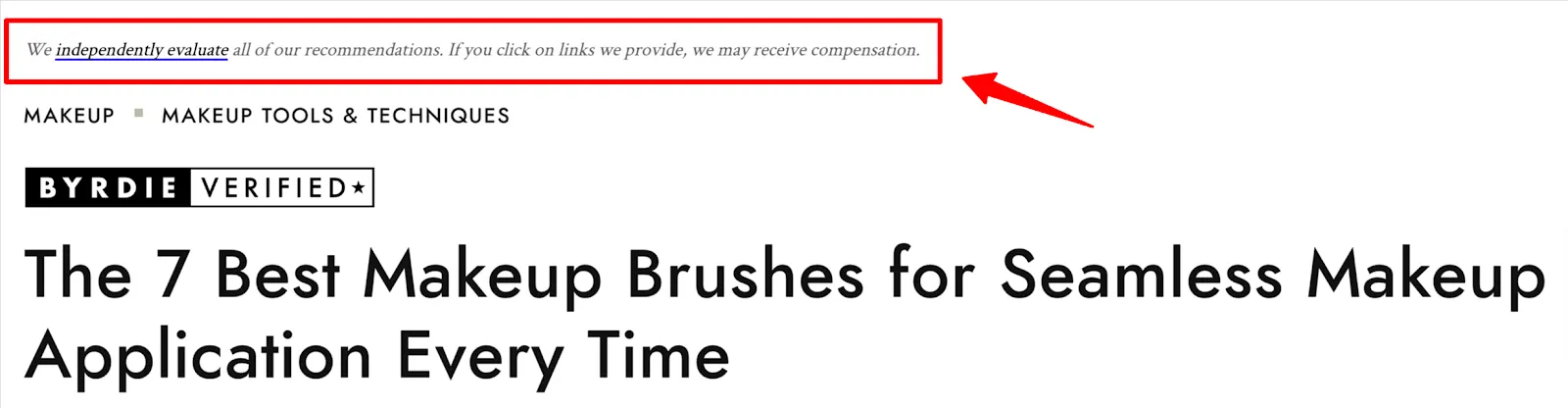
Byrdie also links to an external page for a more detailed explanation of their evaluation and affiliate process.
5. Forbes
Forbes includes highly visible FTC affiliate disclosure text in their blog articles. Here is an example from their best kitchen sink brands article:

Forbes explicitly states that their editors’ opinions are not influenced by commissions, enhancing customer trust in their unbiased decision-making.
FTC affiliate disclosure in a newsletter
6. Digital PR Tips
Digital PR Tips includes a clear affiliate disclosure in their newsletter. It is concise and follows all necessary guidelines.

The final sentence adds that the author only recommends products believed to be useful, further enhancing customer trust. This disclosure seamlessly integrates into the text without disrupting the reader’s flow.
FTC affiliate disclosure in a YouTube video
Emily Norris
For those promoting products/services in YouTube videos, disclosing the brand relationship is crucial. Emily Norris provides an example of how to do so:

The disclosure is included in the product description, an ideal placement. Emily also verbally mentions the affiliate disclosure in the video, further building customer trust.
FTC affiliate disclosure in a social media post
8. Themeparkmomlife
Themeparkmomlife provides an example from Instagram on how to include an affiliate disclosure in a social media post.

The text indicates they received the toys for free for review purposes. While simple, it contains all the necessary information for an affiliate disclosure.


