Imagine giving your team a three-day weekend and still achieving over 50% more work done. Recent tests in various countries revealed that a four-day workweek led to a remarkable 52% increase in productivity. 67% of participants reported feeling less burnt out.
The 4/10 work schedule offers the promise of achieving this balance. It provides employees with full-time hours, a three-day weekend every week, and the opportunity to lead healthier and more engaged lives.
This guide will delve into how the 4/10 schedule operates, its optimal work environments, real-life instances, advantages, disadvantages, and effective implementation strategies.
Summary
- Understand the structure and popularity of a 4/10 schedule.
- Discover which professions and industries benefit most from 4/10 schedules.
- Witness real-world applications of the schedule across various occupations.
- Determine if a 4/10 schedule is suitable for your team or job.
- Utilize time-tracking tools to master the 4/10 schedule effectively.
What does a 4/10 work schedule entail?
Individuals on a 4/10 work schedule operate for 4 days a week, with each day spanning 10 hours, totaling the standard 40 hours. Rather than spreading these hours over five days, the schedule concentrates them into four extended shifts.
It’s straightforward to identify:
- 4 = number of days worked per week
- 10 = hours worked each day
Despite the change in the distribution of work hours, most companies still consider their employees full-time since the total weekly hours remain constant. In most cases, pay, benefits, and workload remain unchanged.
The 4/10 model is just one of many alternative work schedules. Other examples include compressed schedules like 9/80, hybrid work models, and flexible hours. The differentiating factor is that a 4/10 schedule does not reduce working hours; it merely condenses the same hours into fewer days.
Initial misconceptions often arise when businesses explore this model. It is crucial to note that:
- It does not automatically entail additional hours. Employees still work the same 40 hours, albeit rearranged.
- It is not exclusive to blue-collar or physical jobs. More diverse sectors, such as software teams, consulting firms, creative agencies, and engineering groups, are experimenting with shorter work weeks.
- It does not inherently diminish productivity. Research on flexible and compressed work schedules frequently indicates that output either remains stable or improves when individuals can concentrate on their tasks for longer durations uninterrupted.
In essence, the 4×10 schedule offers employees a consistent three-day weekend without reducing their total hours worked. This is achieved by substituting longer workdays for fewer workdays.
How does a 4/10 schedule function in practice?
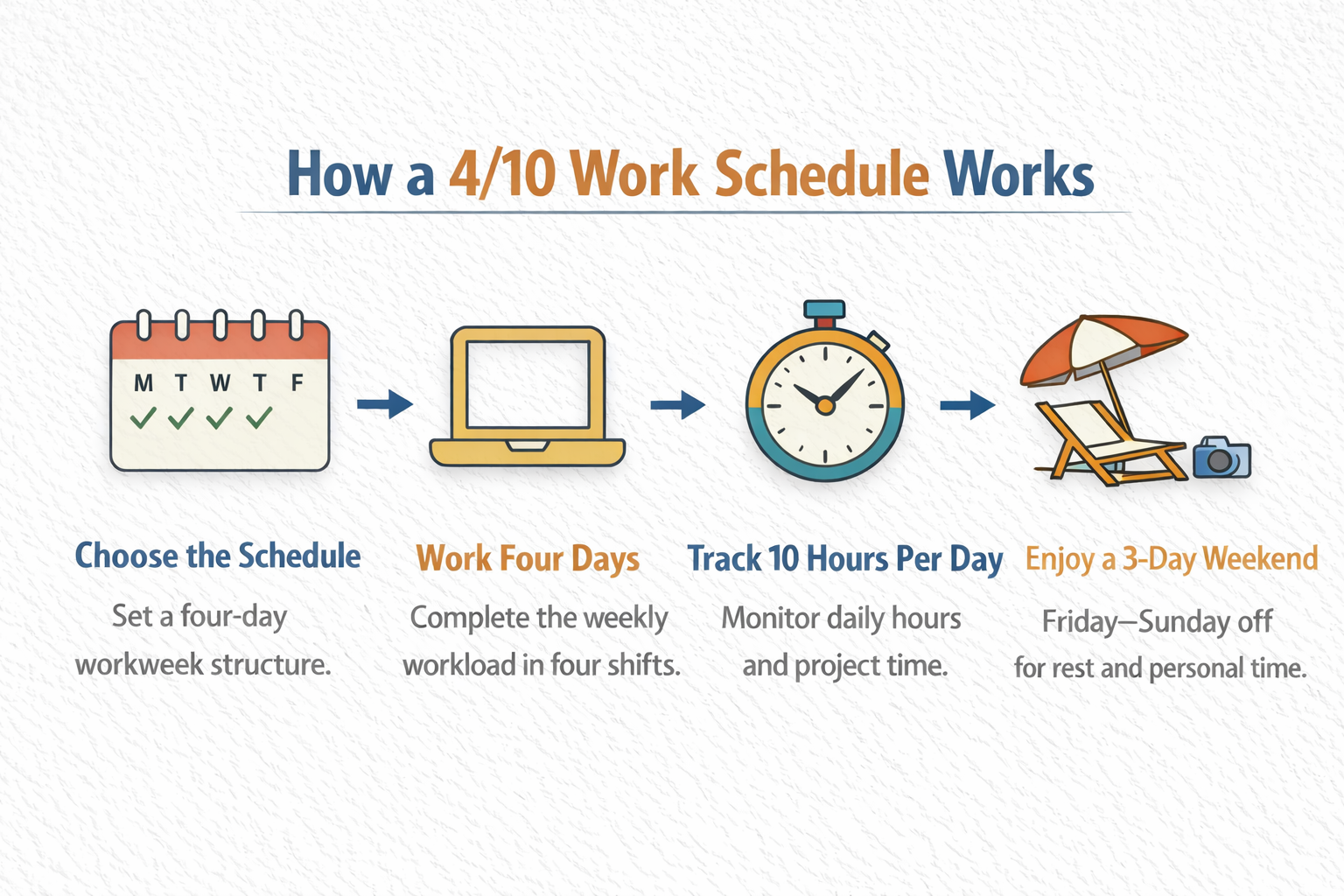
A 4/10 schedule partitions a standard 40-hour workweek into four 10-hour days, affording employees an additional day off. Most companies achieve this by elongating shifts and designating one day as a day off.
This exemplifies a typical structure.
This configuration guarantees a weekly three-day weekend, typically spanning from Friday to Sunday. However, businesses often tailor the structure to align with operational needs, staff capacity, and client availability.
Common strategies for scheduling
The following approaches are prevalent:
- Schedule from Monday to Thursday
This is the most conventional approach. Employees work from Monday to Thursday and enjoy an extended weekend from Friday to Sunday.
- Schedule from Tuesday to Friday
Some companies advance the schedule to ensure coverage on Fridays while granting longer weekends to employees.
Occasionally, larger companies segment teams into units with different days off. For instance, one unit might have Mondays off while another unit might have Fridays off, ensuring continuous coverage during the workweek.
In essence, the objective is clear: maintain the 40-hour workweek while reducing the number of workdays. The precise structure varies based on the necessity to balance productivity, availability, and operational coverage.
Collaboration and productivity
Remote teams can seamlessly adopt a 4/10 schedule due to their familiarity with flexible, asynchronous work methods. They utilize structured coordination to sustain productivity even with an extended weekend.
Primarily, the shortened workweek affords remote teams more time for concentrated work, aligning with reduced meetings and heightened focus. Teams can designate “deep work” days with extended yet fewer workdays and schedule overlapping hours for critical decisions.
Moreover, the extended weekend aids in averting burnout, particularly crucial for remote workers lacking clear boundaries between work and personal life. Ultimately, the 4/10 schedule seamlessly integrates with how remote teams operate, given their adeptness at task management and varied work hours, enabling longer focus spans over fewer days.
Instances of 4/10 work schedules across industries
Professionals capable of segmenting their work into blocks or shifts typically adhere to a 4/10 schedule. Industries reliant on projects or necessitating rotating coverage often leverage this model.
The examples below illustrate how diverse occupations structure compressed schedules.
Software Developers and Engineering Teams
Engineering teams commonly organize their work around four-day development cycles. A prevalent schedule involves coding, testing, and reviewing