“As the cost of traditional online advertising and pay-per-click advertising continues to rise, brands are seeking alternative ways to reach new audiences,” explained Sarah Moret, founder of Curie, to Glossy.
I’m sure many can relate to that sentiment.
With the challenges posed by ad tracking and performance due to the iOS 14 rollout, many marketers are finding it increasingly difficult. However, abandoning ads altogether may not be the best approach, especially if they are your main customer acquisition channel. Instead, focus on implementing precise ad tracking and attribution to better understand what is driving conversions and maximize your ROI.
However, considering diversifying your channels to reduce costs might be a good idea.
And that’s where this article comes in. Let’s explore six other channels and how you can begin utilizing them.
- Influencer marketing
- Partnerships
- Referral program
- Affiliate program
- Content marketing and SEO
- Organic social media
1. Influencer marketing
Over time, brands have shifted from sponsoring only celebrities and influencers with large social media followings to micro and nano-influencers, who have smaller but more engaged audiences.
FIGS’ brand ambassador program

Scrub brand FIGS has hundreds of doctors, nurses, and other healthcare professionals as brand ambassadors. In exchange for free scrubs and event invitations, these ambassadors post about the brand on Instagram and TikTok.
With over 90,000 Instagram posts featuring ” #wearfigs” and TikTok videos with ” #wearfigs” amassing over 288 million views, the strategy is paying off. According to Modern Retail, “These promotional efforts have helped to shape some of the company’s most impressive business metrics. Figs’ customer acquisition cost tumbled 61% between 2018 and 2020 to $39, according to its S-1.”
For more examples, you could look into hint water, Pura Vida Bracelets, and MonkeyFeet.
How to get started with influencer marketing
There is no one-size-fits-all approach to influencer marketing.
FIGS has an application form for interested medical professionals to become ambassadors. On the other hand, some brands use platforms like #Paid, upfluence, TRIBE, and minisocial to find influencers to collaborate with. Some brands offer free gifts, while others provide upfront cash.
If you are just starting out, consider reaching out to your top customers (or top referrers) to gauge their interest in collaboration. Understanding their expectations in exchange (not always monetary) is crucial.
For further insights, Cody Wittick’s ecommerce influencer marketing guide comes highly recommended. Wittick, the Managing Partner at influencer marketing agency Kynship, has assisted numerous brands with their influencer marketing efforts.
2. Partnerships
While challenging to initiate, partnerships can be a valuable way to reach and acquire customers unfamiliar with your brand. Partnerships can also facilitate the creation of unique products, foster audience growth, enhance branding by aligning with similar brands, and more.
CROSSNET and Black Wolf Nation
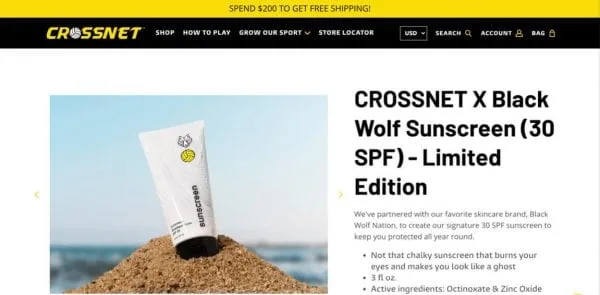
An exemplary win-win partnership is the collaboration between CROSSNET and Black Wolf.
CROSSNET, a brand specializing in four square volleyball nets, teamed up with skincare brand Black Wolf to create a limited edition sunscreen.
Individuals who engage in CROSSNET activities, typically under the sun, would benefit from sunscreen. By partnering with Black Wolf, CROSSNET could offer a product of value to its customers. Simultaneously, Black Wolf gains access to a new audience likely interested in its skincare products.
For more partnership examples, explore Allbirds X adidas, Glossier X Bark, Curie X Lively Root, and Brightland X Oishii.
How to get started with partnerships
Partnerships thrive when the collaborating brands…
- have similar branding
- target similar audiences
- offer complementary products (non-competing)
In the aforementioned example, both CROSSNET and Black Wolf share personal and humorous branding, target outdoor enthusiasts, and cater to individuals concerned about their skin. A perfect match!
Can you identify brands that meet these criteria for your business?
If not, a simple way to begin is by exploring similar accounts suggested by Instagram or surveying your customers on other products they patronize.
For more advanced options, tools like co-op can aid in finding partners, and Quantcast Measure can enhance customer understanding.
3. Referral program
A referral program may not entirely replace ads, but acquiring customers through referrals is significantly more cost-effective than through ads. A Box of Stories and Love Yourself have successfully implemented referral programs to reduce customer acquisition costs.
Riff Raff & Co’s referral program
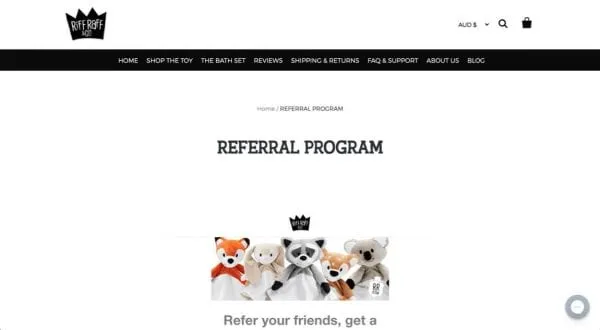
Riff Raff & Co exemplifies a well-suited referral program for its business model.
The brand sells sleep toys for babies and toddlers to mothers. Understanding that mothers often converse about their experiences and trust each other’s recommendations, founder Emma Kruger devised a referral program.
When a new customer makes a purchase through a referral, they receive free shipping. Conversely, individuals referring five new customers earn a free sleep toy (valued at $65). Nearly one in four Riff Raff & Co customers made a purchase through a referral.
For more successful referral program instances, refer to our case studies or this list of top ecommerce referral programs.
How to get started with a referral program
Referrals have proven effective for various products, particularly those in the following categories:
- personal items (e.g., underwear) where trust from a friend outweighs an ad
- products necessitating customer confidence before purchase (e.g., health supplements, skincare) as recommendations hold more weight than ads
- repeat-purchase products (e.g., toiletries) where customers seek discounts for future buys
Success with a referral program is more likely if there is a base of monthly orders (~100) and evidence of customers recommending your brand.
If contemplating a referral program, our 6-step guide can aid in getting started.
4. Affiliate program
An affiliate program is ideal when customers adore your products and desire compensation for recommending them. Affiliates typically earn a percentage of generated sales, ensuring payment only for results obtained.
House of Wise’s affiliate program

House of Wise, a CBD brand focusing on enhancing women’s sleep, sex, stress, and finances, opted for an affiliate model to build trust and confidence in their products. Founder Amanda Goetz elaborated on Banknotes about the decision and its success:
“It was a way to build trust and confidence in our products. The cannabis market can be confusing, and I knew it would be important for women to hear about our products from people who had used them and achieved the desired results in the form of more sleep, better sex, and less stress.”
For more affiliate program examples, explore Goli Nutrition, Chewy, MiaoMiao, and Gymshark.
How to get started with an affiliate program
Some products are better suited for an affiliate program than others. Consider the following questions to initiate the process:
Do customers seek recommendations from trusted sources before trying my products? Some products are impulse buys, while others require persuasion, where an affiliate can assist.
Are my customers inclined to earn from recommending my products? Certain demographics, like bloggers or content creators in fitness, travel, and health niches, may find this appealing.
If considering an affiliate program, our affiliate marketing program guide can guide you through the process.
5. Content marketing and SEO
Having experience in content marketing and SEO at Buffer and ReferralCandy (with millions of monthly pageviews collectively), I can attest to their effectiveness in reducing customer acquisition costs for not only SaaS companies but also ecommerce brands.
Doe Lashes’s organic traffic growth
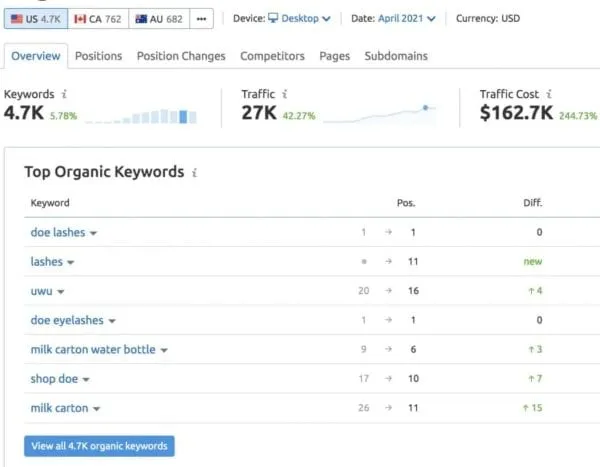
(Screenshot from Jason Wong’s tweet)
With the assistance of an SEO agency, founder Jason Wong boosted Doe Lashes’ monthly organic traffic from 1,800 to 27,000. The brand now ranks for numerous relevant keywords like “lashes.”
Their strategies included creating AMP pages for the website for faster loading, optimizing headers with key keywords, and crafting articles addressing common queries related to their product (e.g., impact of false lashes on real lashes).
Other brands excelling in content marketing include Outdoor Voice, Tortuga Backpacks, and Glossier.
How to get started with content marketing and SEO
As Wong mentioned in his Twitter thread, “SEO is a long game, but it’s something that compounds over time, so the earlier you start, the better.” This mirrors my experiences at Buffer and ReferralCandy, where building consistent, high-volume organic traffic took years.
While ads yield instant results, organic traffic eventually becomes the primary contributor to customer acquisition due to its sustainability and cost-effectiveness. Initially leveraging ads for quick wins while nurturing SEO is a recommended strategy.
For valuable insights on content marketing, SEO, and organic traffic, the Ahrefs blog is an excellent resource. Their comprehensive guide on ecommerce SEO is also worth exploring.
6. Organic social media
Organic social media is a long-term investment. Tracking sales from social media may prove challenging, but its value goes beyond measurable metrics. Enhancing branding and complementing other channels are key benefits.
MeUndies’ organic social media

Consider MeUndies’ Instagram account.
The team consistently unveils new underwear prints and teases upcoming releases on Instagram.
While the team may not track direct sales from Instagram posts, individuals engaging with their content are likely more receptive to MeUndies’ ads or emails, translating to higher conversion rates.
For more brands excelling in social media, explore Three Ships, Muddy Bites, and Tracksmith.
How to get started with organic social media
Initiating social media presence is straightforward, but excelling requires effort. Random posts lack strategy, so experimenting with various content types to gauge audience preferences is essential.
Engage with a multitude of brands on Instagram (or your preferred platform), monitor trends, and test diverse content formats. Entertainment and education are favored content themes worth exploring initially.
The Later blog offers valuable insights on social media strategies, trends, and tips.
What am I missing?
Other customer acquisition channels, such as in-person events, popup stores, and retail expansion, were not covered in this article.
What strategies have worked well for you? What recommendations do you have for fellow marketers?
Share your thoughts in the comments below!
P.S. If you found this article insightful and wish to enhance your ecommerce store, subscribe to our newsletter for the latest articles and roundups.