


The world of cryptocurrency investing and trading is currently experiencing a surge in popularity. As more individuals enter the trading arena each day, many lack the necessary knowledge about cryptocurrencies and trading. For beginners, the market can be unforgiving, often resulting in financial losses. The online space is saturated with dubious trading experts and scam coins preying on unsuspecting victims. However, some cryptocurrencies stand out as worthwhile long-term investments. Let’s explore some of the top cryptocurrencies to consider investing in for 2024.
#1. BITCOIN
Bitcoin, the pioneer cryptocurrency, gave rise to a $2 trillion market. While its price has fluctuated over the years, reaching a peak of $69k USD in November 2024, Bitcoin remains a stable investment. The value of other cryptocurrencies often hinges on Bitcoin’s performance. With increasing acceptance as a legitimate form of payment in several countries, Bitcoin holds a promising future and remains a top contender for investment in 2024.
Pros:
- The most widely accepted and easily tradable cryptocurrency.
- Backed by a large community of developers and investors.
- Abundant resources available for learning about Bitcoin.
Cons:
- High transaction fees and scalability challenges.
- Slow transaction speeds, posing hurdles for scalability.
#2. ETHEREUM (ETH)
Launched in 2015, Ethereum enables the creation of smart contracts and various applications without downtime. The ETH token facilitates trading, security, and decentralization across multiple domains. Popular cryptocurrencies like Tether and Chainlink have emerged within the Ethereum ecosystem. Ethereum’s ERC-10 and ERC-20 tokens offer diverse applications, with the ERC-721 token driving the NFT trend. Positioned at the forefront of crypto innovations, Ethereum continues to be a smart investment choice for 2024.
Pros:
- The leading platform for smart contract development.
- Ethers are essential for executing code on Ethereum, ensuring long-term viability.
- An ideal platform for launching blockchain projects’ Initial Coin Offerings.
Cons:
- Supports only one coding language, Solidity.
- Faces competition from similar platforms.
#3. CARDANO (ADA)

Created by Charles Hoskinson in 2017, Cardano offers scalability and interoperability, distinguishing it from other platforms. Similar to Ethereum, Cardano supports decentralized applications and smart contracts. Notably, Cardano excels in prompt international payments processing. With an open-source development foundation and Proof of Stake validation, Cardano presents a compelling investment opportunity.
Want to know more about Cardano? Here is a complete guideline.
Pros:
- Open-source development framework.
- Utilizes Proof of Stake validation.
Cons:
- Potential flaws in Proof of Stake mechanism.
- Platform requires further testing and validation.
#4. Binance Coin(BNB)

Binance Coin (BNB) serves as the native token of the Binance network, a prominent player in the crypto sphere. Initially operating on the Ethereum blockchain, BNB transitioned to Binance’s proprietary blockchain. Priced at $623.87, BNB boasts a market cap exceeding $100 billion. With the growing popularity of Binance’s platforms and blockchains, BNB is poised to maintain its status as a top cryptocurrency post-Bitcoin and Ethereum.
Pros
- Strong reputation and popularity within the Binance ecosystem.
- Unique burndown policy enhancing token value.
- Exclusive discounts offered on the Binance exchange.
Cons
- Potential regulatory impacts on the coin’s performance.
#5. Polkadot (DOT)

Polkadot facilitates seamless asset and data transfers between blockchains, fostering interoperability among diverse networks. This interoperability fosters a decentralized internet governed by users, streamlining app and service development. Polkadot’s multi-chain transaction processing capability significantly boosts network scalability. Presently priced at $46.06 with a market cap exceeding $45 billion, DOT stands out as a top investment opportunity.
Pros
- Interoperability across multiple blockchains.
- Supported by a skilled and reputable team.
- Enhanced network transparency.
Cons
#6. Solana

Solana has rapidly gained popularity as a high-performance blockchain supporting NFTs, DApps, and smart contracts. Noteworthy for its swift transaction speeds compared to other major blockchains, Solana also employs an eco-friendly proof of stake consensus mechanism. Priced at $227.81 with a market cap exceeding $68 billion, its native token SOL presents a lucrative investment opportunity.
Pros
- Rapid transaction speeds and high interoperability.
- Backed by reliable and esteemed investors.
Cons
- Limited number of validators present a potential challenge.
#7. RIPPLE

Introduced in 2012, Ripple boasts a market cap exceeding $42 billion. Integrated into banking systems and payment networks, Ripple focuses on cost reduction and real-time settlement capabilities. Notably, Ripple excels in facilitating international money transfers within seconds at reduced fees. While not widely accepted for retail transactions, Ripple serves as a transaction protocol for global payments.
Pros:
- Rapid international money transfers with low fees.
- Clear use case in international payments.
Cons:
- Banks and financial institutions, Ripple’s primary users, are developing their own payment cryptocurrencies.
#8. Polygon (MATIC)

Polygon serves as an interchain scalability solution enabling blockchain networks to interconnect. By combining the flexibility and scalability of alternative blockchains with Ethereum’s security, liquidity, and interoperability, Polygon stands out. Comprising developers, clients, stakeholders, and more, the Polygon network fosters collaboration on various Ethereum-based dapps. Offering superior speed and affordability, Polygon emerges as a preferred network for diverse applications.
Pros:
- Interoperability, scalability, and strategic partnerships.
- Backed by reputable investors.
Cons:
- Competition from similar technologies.
#9. Uniswap (UNI)

Decentralized finance (DeFi) has gained momentum, with Uniswap emerging as a leading DeFi trading platform. Leveraging automated market maker protocol, Uniswap provides liquidity to users, automates trading, and enhances efficiency over traditional exchanges. Solving liquidity challenges of early DeFi platforms, Uniswap offers seamless token trading, priced at $16 with a market cap exceeding $10 billion.
Pros:
- Offers privacy, speed, safety, low fees, global reach, and rapid transaction verification.
- Token usability for trading goods, distinguishing it from other currencies.
Cons
- Scalability challenges with limited block size, hindering transaction processing.
#10. Chainlink (LINK)

Chainlink facilitates interconnected smart contract creation across blockchains using a decentralized oracle network. This network enables secure processing of external components required for complex smart contract agreements. With a robust community comprising operators, developers, and researchers, Chainlink offers real-world applications and increasing smart contract adoption. Priced at $20.1 with a market cap exceeding $10 billion, Chainlink remains a top choice for 2024 investments.
Pros:
- Promising project with valuable partnerships.
- Real-world applications enhancing utility.
Cons:
Promote Your Own Cryptocurrency using Cryptocurrency MLM Software
Explore some intriguing insights into the top 10 cryptocurrencies for your reference.
1. Why is Bitcoin considered the premier cryptocurrency among the top 10?
With a market capitalization surpassing $100 billion, Bitcoin stands out as the most widely accepted and easily tradable cryptocurrency, supported by a large investor community.
2. Which cryptocurrency is ideal for smart contract development?
Ethereum is the preferred cryptocurrency for building smart contracts.
3. Which cryptocurrencies boast zero transaction fees?
Litecoin and IOTA are notable for offering zero transaction fees.
4. Which cryptocurrencies from the top list are recommended for investing in 2024?
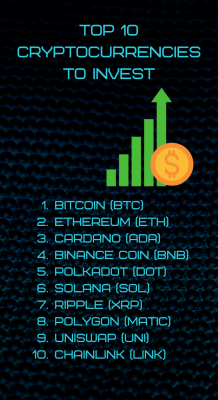
The top cryptocurrencies for investment in 2024 are:
- Bitcoin
- Ethereum
- Cardano
- Binance Coin
- Polkadot
- Solana
- Ripple
- Polygon
- Uniswap
- Chainlink
5. Which cryptocurrency in the top list operates without blockchain technology?
IOTA stands out as the cryptocurrency utilizing tangle technology instead of blockchain, based on mathematical acyclic graphs.
Conclusion
While Bitcoin commands significant attention in the cryptocurrency realm, numerous alternative investment opportunities abound. The cryptocurrency landscape is dynamic, with new contenders continually emerging.
Did you know you can create your own cryptocurrency? Cryptosoftwares offers leading Cryptocurrency and Blockchain Application Development Services.


