


Many project managers rush or underestimate project cost estimation, leading to 85% of global projects running over budget by an average of 28% higher than the original estimate. The main reasons include unclear project scope, missing risk buffers, and estimates based on guesses rather than careful planning.
The solution? Structured project cost estimation, using proven techniques and real data, provides teams with the financial visibility needed to deliver on time and on budget.
This guide details how cost estimation in project management works, the five most reliable estimation techniques, a step-by-step process for building estimates, a practical example, and tools to remove guesswork.
Summary:
- Understand the importance of cost estimation in project success.
- Select the right technique with clear accuracy trade-offs.
- Build defensible estimates with a proven five-step process.
- Apply a real worked example to your own projects.
- Utilize TMetric’s real-time tracking to replace budget guesswork.
What is project cost estimation in project management?
Project cost estimation involves determining the actual amount of money required to complete a project by reviewing scope, timeline, labor, tools, and materials to create a realistic forecast of total cost.
It’s important to note that estimation is not the same as budgeting. Estimation precedes budgeting and is an informed forecast based on available data, while a budget is the approved allocation of funds for the project. Failing to differentiate between the two often results in revised numbers later on.
Cost estimates evolve as a project progresses. Early estimates, also known as rough-order-of-magnitude (ROM) estimates, can be off by up to ±50%. As the project becomes clearer and planning improves, these estimates become more accurate, reaching around ±10% precision.
Central to cost estimation is the project management iron triangle: scope, time, and cost are interconnected. When one changes, the others typically adjust as well. A reliable cost estimate hinges on a clear scope and realistic timeline; otherwise, the numbers are merely optimistic guesses.
Get budget estimates instantly and use work types for any project
Explore the latest TMetric release featuring tools that streamline project budget calculation and enable the use of work types for any project irrespective of billing. Additionally, you can now sort tasks by estimate to better manage task execution.
Why accurate project cost estimation matters
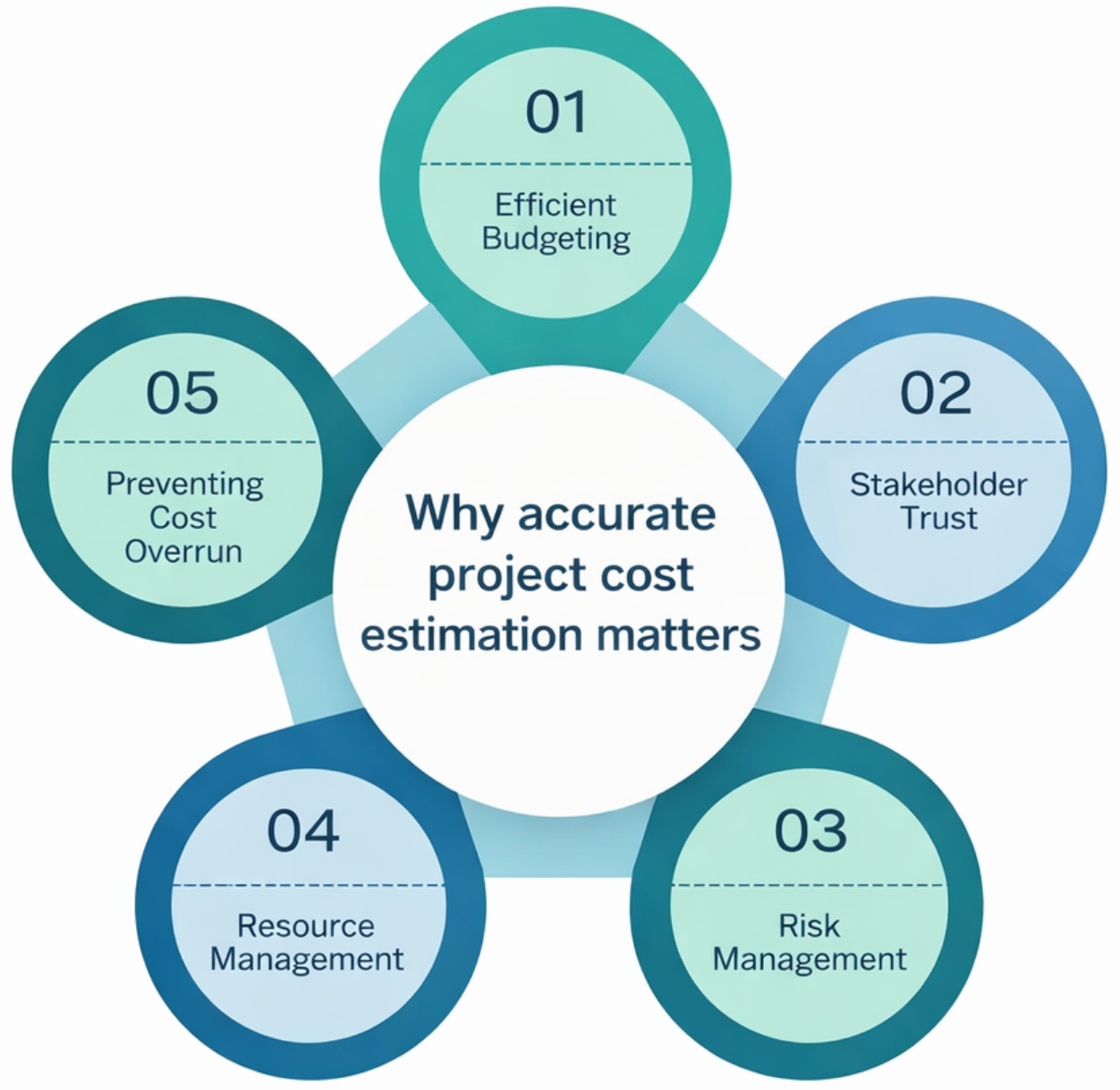
Poor estimates not only impact the budget but also erode stakeholder confidence, delay timelines, and force teams into reactive decisions later in the project. A study of 99 public building projects revealed that 58% exceeded budget, 78% fell behind schedule, and nearly half experienced both. Often, this stems from treating estimation as a quick formality rather than a meticulous planning step.
Accurate project cost estimation can change this narrative by delivering:
- Higher funding approval rates: Credible numbers expedite approval.
- Better resource alignment: Ensuring the right people and tools are in place before work commences.
- A shared financial baseline: A figure that leadership, clients, and teams can align on.
- Early risk detection: Identifying scope creep before issues escalate.
- Transparent cost communication: No surprises at delivery, only informed decisions throughout.
Projects that prioritize rigorous estimation consistently outperform those that treat it as a mere checkbox.
Key components of a project cost estimate
Project cost estimates must consider both obvious expenses and often overlooked, quieter costs. Most estimates comprise six core elements:
- Labor costs: Typically the largest expense, calculated from hours worked per role multiplied by hourly rates.
- Materials and equipment: Physical resources required for project delivery, ranging from hardware to rented equipment.
- Software and tools: Licenses, subscriptions, and platforms utilized during execution.
- Overhead and indirect costs: Administrative support, infrastructure, and shared services that still consume resources.
- Contingency reserves: Usually 10–15% of the estimate to cover known risks.
- Risk allowances: Additional provision for potential issues that are possible but not yet fully defined.
A common mistake in project cost estimation is overlooking indirect costs. Infrastructure usage, compliance requirements, and project management time often contribute to higher final costs if not accounted for early on.
Project Evaluation: Guide to Methods, Steps, and Importance
Learn how to conduct a comprehensive project evaluation with our step-by-step guide. Understand the significance of project evaluation and the key elements to consider for effective assessment.

Project cost estimation techniques explained

The choice of cost estimation technique impacts the accuracy and defensibility of the final estimate. No single method suits every project, as the right approach depends on available project details, time constraints, and stakeholder expectations regarding accuracy at that stage. Let’s delve into the techniques.
Analogous estimating
Analogous estimating utilizes information from similar past projects to generate a quick, high-level project cost estimate. It is typically used in early planning stages when project details are scarce, providing stakeholders with a rough number to evaluate project viability.
The drawback lies in accuracy, as these estimates usually fall within a range of ±30–50%. While suitable for preliminary feasibility assessments, they are not reliable enough for final project budgets. The method is most effective when the reference past project closely aligns in scope, technology, and team composition. Comparing a software project to a hardware project, for instance, rarely yields a meaningful estimate.
Parametric estimating
Parametric estimating leverages statistical relationships and cost-per-unit calculations to formulate a project cost estimate. Instead of relying on general similarities, it works with measurable variables such as cost per hour, cost per square foot, or cost per function point, using historical data to scale the estimate.
This method can provide fairly accurate results when backed by reliable data and clearly defined project variables. It typically requires more preparation than analogous estimating but less effort than a full bottom-up estimate, making it a valuable middle ground between rough estimates and detailed planning.
Bottom-up estimating
Bottom-up estimating involves calculating costs for individual tasks or work packages and aggregating them to derive the total project cost estimate. While generally the most accurate method, it is also the most time-consuming, as the project must first have a detailed Work Breakdown Structure.
Engaging the delivery team in estimating each task often uncovers cost factors overlooked in top-down estimates. However, there is a risk of teams leaning towards optimistic assumptions unless these estimates are meticulously reviewed and scrutinized.
Three-point estimating (PERT)
Three-point estimating minimizes uncertainty by outlining three cost scenarios:
- Optimistic (O)
- Pessimistic (P)
- Most likely (M)
The PERT formula, (O + 4M + P) ÷ 6, calculates a weighted average that assigns four times more weight to the most likely outcome, yielding a defensible range rather than a singular fragile number.
This technique proves especially valuable in high-risk or ambiguous environments where a point estimate would mask significant variability. By delineating three independent scenarios, teams are compelled to confront potential challenges explicitly and incorporate them into the project budget before initiation rather than discovering them midway through execution.
Expert Judgment
Expert judgment relies on the experience of individuals who have managed similar projects in the past. When historical data is scarce, ambiguous, or absent, their input can help fill the gaps that models or formulas cannot address independently.
However, it’s crucial not to consider expert judgment a shortcut. It is most effective when multiple experienced professionals offer their input independently, explain their assumptions, and openly compare their estimates instead of merely averaging them. When combined with other estimation techniques, expert judgment enhances the reliability of cost estimates.
Technique comparison
| Technique | Accuracy level | Data requirement | Best use case | Time to prepare | Risk sensitivity |
| Analogous Estimating | Low–Medium | Limited historical data from similar projects | Early-stage planning with minimal project details | Very fast | Low |
| Parametric Estimating | Medium–High | Reliable historical metrics and cost-per-unit data | Projects with measurable, repeatable components | Moderate | Medium |
| Bottom-Up Estimating | High | Detailed task-level breakdown and resource data | Complex projects requiring precise cost estimates | Time-Intensive | Medium–High |
| Three-Point Estimating (PERT) | Medium–High | Scenario-based inputs (optimistic, pessimistic, most likely) | Projects with uncertainty and variable conditions | Moderate | High |


